

外掛說明
SkyeGate is condition-based access for WordPress: recognition, not passwords. Visitors connect a wallet, SkyeGate checks the conditions you set through InsumerAPI (the condition-based access API), and qualifying visitors see your content. Nothing to sign up for, nothing to leak, and no personal data collected. Your site never sees balances or holdings, just a signed yes or no.
Free and fully functional. Install, add a shortcode, and start gating content immediately. No API key or account required.
What you can gate by
- Membership passes: recognize community membership passes created with SkyeMeta’s Bothy. Members prove it’s them with a one-time code sent to their email, no wallet app needed
- Token balance: require visitors to hold a minimum amount of any ERC-20 or SPL token
- NFT ownership: require visitors to own an NFT from a specific collection
- EAS attestations: require on-chain attestations via Ethereum Attestation Service
- Native tokens: gate by ETH, SOL, POL, and other native chain tokens
Supported chains
Ethereum, Solana, Polygon, Arbitrum, Base, Optimism, BNB Chain, Avalanche, XRP Ledger, and 23 more (32 blockchains total).
How it works
- Add the
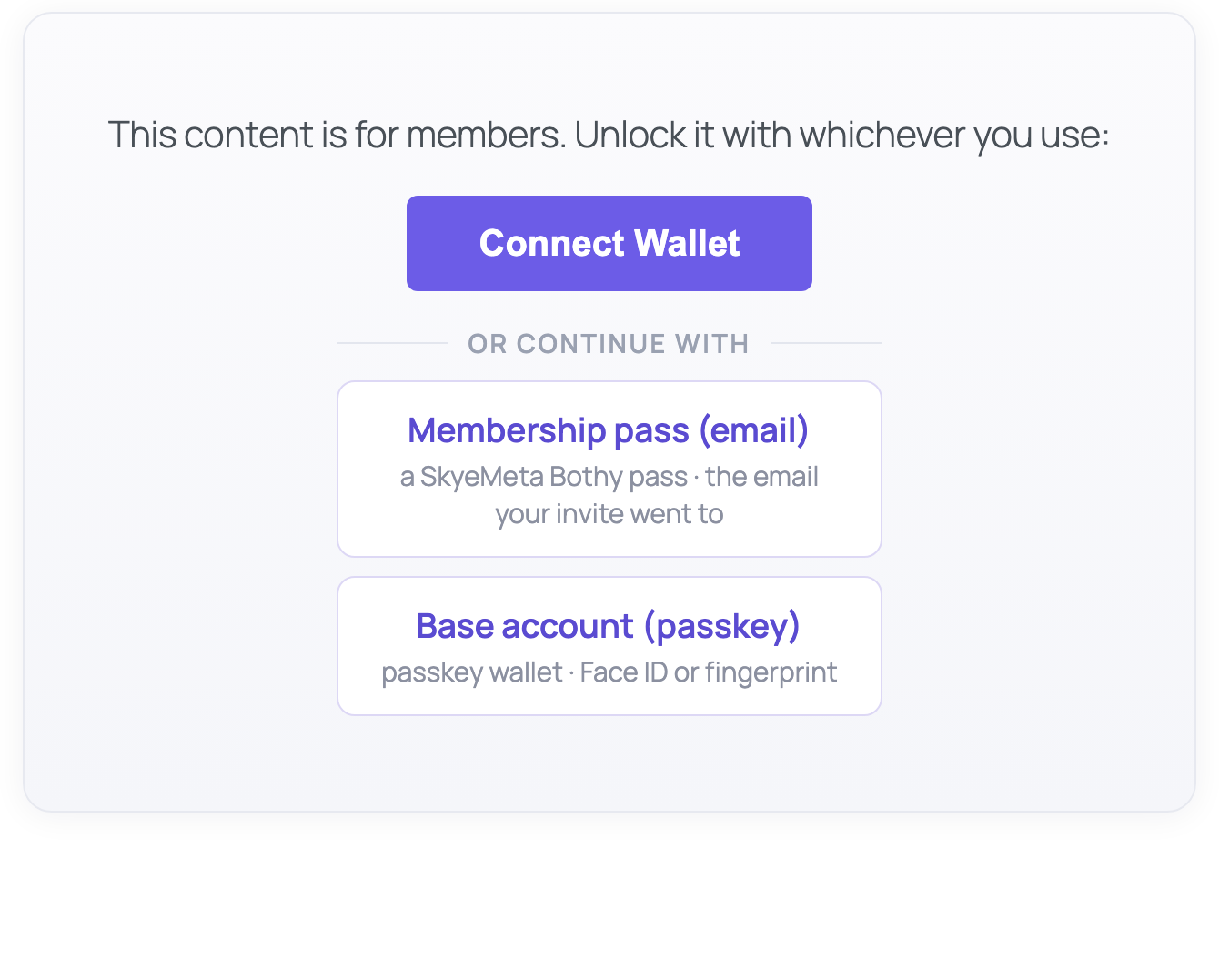
[skyegate]shortcode around any content - Visitors see a “Connect Wallet” button
- After connecting, SkyeGate verifies their holdings via InsumerAPI
- If they qualify, the gated content is revealed (loaded server-side, not in page source)
Wallets supported
MetaMask, Phantom (EVM + Solana), Coinbase Wallet, Coinbase Smart Wallet (passkey, no extension needed), and any wallet that supports EIP-6963.
Need more? SkyeGate Pro
The free plugin runs one condition per gate, forever. SkyeGate Pro stacks up to 10 conditions per gate, adds Farcaster conditions, covers 32 chains, and one license works on both WordPress and Vercel. SkyeGate is part of SkyeMeta’s Recognition Network: one membership, recognized everywhere.
External Services
This plugin connects to two external services for wallet verification. No personal data is collected or transmitted; only public blockchain wallet addresses and your site domain are sent.
SkyeGate API (skyemeta.com)
When a visitor connects their wallet, the plugin sends a POST request to https://skyemeta.com/api/verify with the visitor’s public wallet address, the gate conditions you configured, and your site domain. The service returns a signed verification result. This happens each time a visitor attempts to access gated content.
InsumerAPI (api.insumermodel.com)
To verify that the returned attestation was genuinely signed by InsumerAPI and has not been tampered with, the plugin fetches a public signing key (JWKS) from https://api.insumermodel.com/.well-known/jwks.json. No user data is sent; this is a public key fetch, cached for 24 hours.
Source Code
The unminified source for public/js/skyegate-wallet.js is included in the plugin at src/wallet.js. The minified file is built with Vite using npm run build. The build configuration is in package.json and vite.config.js.
螢幕擷圖

安裝方式
- Upload the
skyegatefolder to/wp-content/plugins/or install via the WordPress plugin directory - Activate the plugin through the Plugins menu
- Add a
[skyegate]shortcode to any post or page, it works immediately - Optionally configure default chain, button text, and gate style under Settings > SkyeGate
常見問題集
-
Do I need an API key to get started?
-
No. SkyeGate includes InsumerAPI verification out of the box. No API key or account required.
-
What wallets are supported?
-
MetaMask, Phantom (EVM + Solana), Coinbase Wallet, and any wallet that supports EIP-6963. Visitors without a wallet extension can use a Coinbase Smart Wallet: a passkey wallet that opens in a popup, no install required.
-
Can I gate by Solana tokens?
-
Yes. Use
chain="solana"in the shortcode. Phantom wallet connects automatically for Solana verification. -
Yes. Gated content is stored server-side and only delivered via AJAX after wallet verification passes. It is not present in the page source.
-
Is user data collected?
-
No. SkyeGate uses InsumerAPI to check on-chain data (token balances, NFT ownership). Verification results are cryptographically signed (ECDSA + JWKS). No personal information, email addresses, or wallet contents are stored.
使用者評論
這個外掛目前沒有任何使用者評論。
參與者及開發者

變更記錄
1.2.0
- New: “Membership pass (email)” on every gate. Visitors whose community pass lives in an email wallet (a SkyeMeta Bothy pass) connect through a secure window on the pass’s own site: they approve once and the gate verifies as usual. No app, no extension, nothing installed
- Clearer gate: “Connect Crypto Wallets” says what it does, the passkey option carries its current Base account name, and each alternative explains who it’s for
- Works alongside every existing wallet connection, nothing changes for MetaMask, Phantom, Coinbase, GemWallet, or Crossmark
1.1.0
- New: Coinbase Smart Wallet (passkey) support. Visitors without a wallet extension can connect with a passkey popup; the Coinbase Wallet SDK ships inside the plugin and loads only when chosen (no CDN)
- Clearer guidance when no browser wallet is detected
1.0.4
- Single-condition gates on 31 blockchains (token balance, NFT ownership, EAS attestation)
- Multi-wallet: MetaMask, Phantom, Coinbase Wallet, and any wallet supporting EIP-6963
- Cryptographically signed verification results (ECDSA + JWKS), verified on the server before content release
- Server-side content delivery: gated HTML is never present in the page source
- Per-visitor session binding so a verification in one browser does not unlock gated content in another
- Built-in caching to minimize verification calls