Title: StoreSeeder – Dummy & Test Data Generator for WooCommerce & Fluent Cart
Author: Al Amin Ahamed
Published: 2026 年 7 月 30 日
Last modified: 2026 年 8 月 7 日
---
搜尋外掛
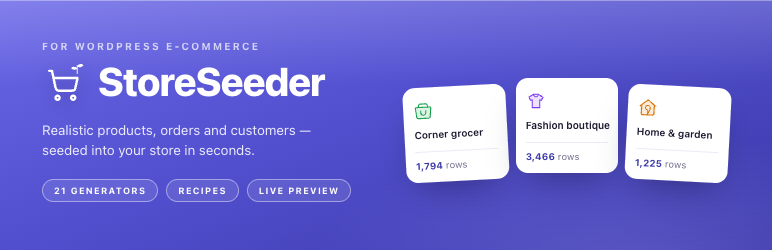

# StoreSeeder – Dummy & Test Data Generator for WooCommerce & Fluent Cart
由 [Al Amin Ahamed](https://profiles.wordpress.org/mralaminahamed/) 開發
[下載](https://downloads.wordpress.org/plugin/storeseeder.1.2.0.zip)
[即時預覽](https://tw.wordpress.org/plugins/storeseeder/?preview=1)
* [詳細資料](https://tw.wordpress.org/plugins/storeseeder/#description)
* [使用者評論](https://tw.wordpress.org/plugins/storeseeder/#reviews)
* [安裝方式](https://tw.wordpress.org/plugins/storeseeder/#installation)
* [開發資訊](https://tw.wordpress.org/plugins/storeseeder/#developers)
[技術支援](https://wordpress.org/support/plugin/storeseeder/)
## 外掛說明
StoreSeeder generates realistic test data for **WooCommerce** and **Fluent Cart**—
products with real prices and stock, customers with plausible addresses, and orders
that point at both. It helps developers, agencies and store owners build datasets
for testing, client demos and performance work without hand-crafting records.
Build a whole coherent shop in one click with a **recipe** — a corner grocer, a
fashion boutique, a home & garden store — or generate one resource at a time with
a live preview of exactly what a run will create.
Where the data lands is decided by a **platform driver**, and the same twenty-one
generators feed every driver. **Fluent Cart and WooCommerce are included today**;
drivers for other platforms are planned, and the registration filter is public,
so a third party can add one from their own plugin without changes here.
All data is created through the target platform’s own models, so generated records
respect the same validation, relationships, and business logic as real data and
stay compatible with that platform’s updates.
**Sample data is optional and consent-based.** StoreSeeder can download locale-specific
reference data (product names, addresses, customer tags) from GitHub to make generated
content more realistic. Nothing is downloaded until you accept a one-time consent
prompt on the plugin’s admin page. After that, StoreSeeder will re-fetch the files
if they go missing. No data about your site is ever transmitted, and declining costs
you no functionality — generators fall back to built-in defaults. You can change
the decision at any time from Settings.
**Highlights**
* **21 generators** — products, product variations, categories, tags, brands, customers,
orders, transactions, refunds, coupons, shipping plans, shipping classes, tax
classes, order tax lines, attributes, cart sessions, labels, product downloads,
subscriptions, licences, and activity logs.
* **One driver per platform** — the generators are platform-neutral, so the same
fixed seed produces identical data wherever it is written. Fluent Cart and WooCommerce
ship; the driver layer is public for the rest.
* **Modern admin** — a single-page React app (React Router v7, Tailwind CSS v4,
lucide icons) that adapts to your WordPress admin color scheme.
* **Live preview** — a read-only preview of real faker rows that refreshes as you
change settings, without persisting anything.
* **75 locales** — names, addresses, phone numbers, and postcodes in any locale
FakerPHP ships a provider for. The picker offers exactly what the REST API accepts,
searchable by name or code.
* **Schema-driven configuration** — each generator renders its own fields from
a parameter schema: nested options, ranges, toggles, and intelligent defaults.
* **REST API** — every generator is exposed at `storeseeder/v1//generate`
for programmatic use.
* **WP-CLI** — `wp storeseeder generate products --count=20 --locale=de_DE`, plus
preview, platform and locale commands. The same controllers as the REST API,
so nothing can drift.
* **Translation-ready** — every string passes through gettext and the plugin’s
own `languages` directory is registered, so Loco Translate and WPML String Translation
pick the admin up without configuration.
* **One-click cleanup** — delete the data StoreSeeder generated, tracked in its
own ledger so your own rows are never matched on.
* **Optional MCP integration** — expose generators as AI tools via the WordPress
Abilities API (see below).
* **Extensible** — filters and actions cover the full generation lifecycle, one
filter registers a whole platform, and one filter sets the capability required
to use the plugin.
**Generators**
* **Products** — pricing, inventory, and content, created as a sellable product(
post, product detail, and variation rows).
* **Product Variations** — additional priced variations attached to existing products,
with unique SKUs.
* **Customers** — demographics, billing and shipping addresses, purchase history,
and contact preferences.
* **Orders** — line items, billing and shipping addresses, applied coupons, payment,
shipping, tax, and status distribution.
* **Transactions** — payment transactions tied to real orders.
* **Refunds** — full and partial refunds created against existing charge transactions.
* **Coupons** — discount types, usage limits, validity windows, and restrictions.
* **Shipping Plans** — shipping methods and zones.
* **Shipping Classes** — groups of products with similar shipping requirements.
* **Tax Classes** — tax classes with geographic rate rows.
* **Order Tax Lines** — per-order tax lines linking orders to tax rates.
* **Attributes** — attribute groups and terms, linked to real product variations.
* **Product Categories** — categories, nested where asked, with existing products
filed under them. Needs a platform that has them: WooCommerce, EasyCommerce and
Fluent Cart all do.
* **Product Tags** — tags applied to existing products. WooCommerce and EasyCommerce
have tags; Fluent Cart does not, and says so rather than inventing somewhere
to put them.
* **Brands** — product brands attached to existing products, optionally nested
as sub-brands. Needs a platform that has brands: WooCommerce, EasyCommerce and
Fluent Cart do.
* **Cart Sessions** — abandoned and active cart sessions.
* **Labels** — labels (tags) attached to existing orders and customers.
* **Product Downloads** — downloadable files for products, with download permissions
on existing orders.
* **Subscriptions** — subscription records against existing orders (on Fluent Cart,
active billing requires Pro).
* **Logs** — activity log entries across orders, products, customers, and system
events.
**Deleting generated data**
Settings has a Danger zone action that deletes what StoreSeeder created — products,
orders, customers and everything hanging off them — with a per-resource breakdown
of what will go. `wp storeseeder cleanup delete` does the same from WP-CLI.
It deletes only rows the plugin recorded creating, in its own ledger table. Nothing
is ever matched on for resembling test data, so a staging site restored from production
keeps its real catalogue. Data generated before this version was released is not
in the ledger and is not offered.
**Model Context Protocol (MCP) Integration**
The plugin can optionally expose each generator as two MCP tools so AI clients (
e.g. Claude Desktop, IDE assistants) can work with test data in natural language:
a read-only preview that shows the rows a run would create, and a generate tool
that creates them. Settings has one switch per risk class — enable AI tools, allow
preview tools, allow generating — and each is a registration gate, so a tool that
is switched off is never offered to a client at all. Only administrators can change
them.
The tools are served at `/wp-json/storeseeder-mcp/mcp`, and are also reachable through
the `mcp-adapter` plugin’s own default server for clients already configured against
it. A desktop client connects through Automattic’s `mcp-wordpress-remote` proxy (
https://github.com/Automattic/mcp-wordpress-remote), using an application password
for a user who has StoreSeeder access; that repository documents the setup and the
current config format. This requires the WordPress Abilities API (bundled in WordPress
6.9+, or installable separately) and the `mcp-adapter` plugin. MCP is entirely optional
and degrades gracefully — the plugin works normally when these dependencies are
absent.
#### More from us
Other free plugins by the same author, all on WordPress.org.
**If you are seeding a store, you may also want**
* [EasyCommerce FakerPress](https://wordpress.org/plugins/easycommerce-fakerpress/)–
The same idea for an EasyCommerce store, with a live preview before anything
is written.
* [StoreSheet](https://wordpress.org/plugins/storesheet/) – Sync WooCommerce products,
orders and coupons to a Google spreadsheet, one way and in the background.
**For a WooCommerce store**
* [Warranty Cart](https://wordpress.org/plugins/warranty-cart/) – Sell extended
warranties on your products, then handle the claims and renewals that follow.
* [Vendor Tasks for Dokan & ClickUp](https://wordpress.org/plugins/alamin-vendor-tasks-dokan-clickup/)–
Turn Dokan vendor events into ClickUp tasks — registrations, approvals, withdrawals.
**For any site**
* [Swift Menu Duplicator](https://wordpress.org/plugins/swift-menu-duplicator/)–
Duplicate menus in one click, snapshot revisions, export and import, WP-CLI and
REST.
* [Author Profile Blocks](https://wordpress.org/plugins/author-profile-blocks/)–
Author and team profiles as Gutenberg blocks — grid, carousel, list and single.
### External services
StoreSeeder connects to GitHub and to WordPress.org. Nothing is contacted on activation,
every request is administrator-initiated, and no personal or store data is ever
transmitted.
**1. GitHub — sample data repository**
Locale-specific reference data (product names, addresses, customer tags) used to
make generated content more realistic. Downloaded only after an administrator accepts
the consent prompt on the plugin admin page — that prompt is the only way permission
is granted. Until it is, “Sync now” and “Force re-sync” on the Settings page open
the prompt instead of downloading. Once permission is on record, “Sync now” downloads;
nothing is fetched on page load or on a schedule. Declining leaves every generator
working from built-in defaults, and the decision can be changed from Settings at
any time.
**2. WordPress.org — plugin directory API**
The “Our Plugins” admin page lists the plugin author’s other WordPress.org plugins
with live ratings and install counts. Requested by the browser, only when an administrator
opens that page.
**3. GitHub — recipe repository**
Store recipes: the vocabulary that makes every generator produce one coherent shop.
Downloaded only when an administrator presses “Download the recipes” on the Recipes
page, and only once the consent prompt above has already been accepted — one consent
record covers both, because asking twice for the same answer trains people to click
through prompts. Unlike the sample data this is never fetched implicitly. Declining
or ignoring it leaves the rest of the plugin unaffected.
The full disclosure for each service — endpoint, exactly when the request is made,
what is sent and received, and the provider’s terms of service and privacy policy—
is documented here:
[Read the external services disclosure](https://mralaminahamed.github.io/storeseeder/reference/external-services/)
### Source code
The minified JavaScript and CSS in `build/` is compiled from the TypeScript and
CSS sources in `src/`, which are not included in the distributed plugin package.
The complete, human-readable source is public:
[Browse the StoreSeeder source on GitHub](https://github.com/mralaminahamed/storeseeder)
Build tooling is webpack (via @wordpress/scripts), TypeScript, and Tailwind CSS,
configured by `webpack.config.js`, `tsconfig.json`, and `postcss.config.js` in the
repository root. The build steps are listed under “Development Setup” above; local
setup, the full toolchain, and the quality gates are documented here:
[Read the contributing guide](https://mralaminahamed.github.io/storeseeder/reference/contributing/)
### Privacy
All generated data is stored in your own WordPress database and is never transmitted
anywhere. Generated content is fictional and does not represent real individuals
or transactions. The plugin does not collect analytics and does not phone home.
The plugin makes two outbound requests, both administrator-initiated and both carrying
no site data — see the “External services” section above, and [the external services disclosure](https://mralaminahamed.github.io/storeseeder/reference/external-services/)
for the full detail.
### Contributing
Development happens on [GitHub](https://github.com/mralaminahamed/storeseeder).
Bug reports, feature requests, and pull requests are all welcome — the [issue tracker](https://github.com/mralaminahamed/storeseeder/issues)
is the place to start. Setting up, the quality gates, and how to add a platform
driver, a generator or a recipe are documented here:
[Read the contributing guide](https://mralaminahamed.github.io/storeseeder/reference/contributing/)
## 螢幕擷圖
[⌊Dashboard — run totals, recent activity, and all 21 generators grouped by category.⌉⌊
Dashboard — run totals, recent activity, and all 21 generators grouped by category
.⌉[
Dashboard — run totals, recent activity, and all 21 generators grouped by category.
[⌊Recipes — three ready-made shops, each itemised per resource, built in dependency
order from one click.⌉⌊Recipes — three ready-made shops, each itemised per resource,
built in dependency order from one click.⌉[
Recipes — three ready-made shops, each itemised per resource, built in dependency
order from one click.
[⌊Product generator — product type, price range, inventory and content options,
with a live preview of the rows the run will create.⌉⌊Product generator — product
type, price range, inventory and content options, with a live preview of the rows
the run will create.⌉[
Product generator — product type, price range, inventory and content options, with
a live preview of the rows the run will create.
[⌊Order generator — status mix, items per order, payment methods and geography,
with the preview updating as settings change.⌉⌊Order generator — status mix, items
per order, payment methods and geography, with the preview updating as settings
change.⌉[
Order generator — status mix, items per order, payment methods and geography, with
the preview updating as settings change.
[⌊Settings — where data is written, who may write it, and the AI tool switches.⌉⌊
Settings — where data is written, who may write it, and the AI tool switches.⌉[
Settings — where data is written, who may write it, and the AI tool switches.
## 安裝方式
#### Automatic Installation
1. Go to **Plugins Add New** in your WordPress admin.
2. Search for “StoreSeeder”.
3. Click **Install Now**, then **Activate**.
4. Open the new **StoreSeeder** menu item.
#### Manual Installation
1. Download the plugin ZIP.
2. Upload it to `/wp-content/plugins/storeseeder/`.
3. Activate via the **Plugins** screen.
4. Open the **StoreSeeder** menu.
#### Development Setup
1. Clone: `git clone https://github.com/mralaminahamed/storeseeder.git`
2. Install dependencies: `composer install && yarn install`
3. Build assets: `yarn build`
4. Activate the plugin.
#### Requirements
* WordPress 6.5+
* PHP 7.4+ (8.0+ recommended)
* One supported e-commerce platform, active. Today: Fluent Cart or WooCommerce.
StoreSeeder activates without it and tells you what is missing, rather than blocking
activation — blocking would rule out every other platform.
* 256MB memory minimum (512MB for large datasets)
* MCP integration (optional): WordPress Abilities API + `mcp-adapter` plugin
## 常見問題集
### How do I create dummy products in WooCommerce?
Install StoreSeeder, open the **StoreSeeder** menu, and choose **Products**. Set
the price range, stock and product type, check the live preview, then press Generate.
Products are created through `WC_Product`, so they behave exactly like products
you added by hand. For a whole catalogue with categories, brands, variations and
orders against it, use a recipe instead.
### How do I add test orders to Fluent Cart or WooCommerce?
Use the **Orders** generator. Orders need products and customers to exist first —
they draw from what is in the store rather than inventing it — so generate those
two first, or run a recipe, which fills nine resources in dependency order for you.
Order totals are the sum of the real catalogue prices of the products each order
points at, so revenue reports agree with the store.
### Can I delete the test data afterwards?
Yes, exactly. Every row StoreSeeder writes is recorded in its own ledger, and **
Settings Danger zone Delete generated data** removes what it created and nothing
else. No date ranges, no name matching — a staging site restored from production
keeps its real catalogue.
### Which e-commerce platforms are supported?
Fluent Cart and WooCommerce today. Fluent Cart covers 20 of 21 resources — licences
need Fluent Cart Pro, which owns the licensing tables, and StoreSeeder says so rather
than hiding the generator. WooCommerce covers 18: subscriptions need WooCommerce
Subscriptions, and transactions, labels and licences are reported unsupported with
the reason, because WooCommerce has no equivalent for them and no plugin changes
that. Support is provided by a platform driver rather than wired into the generators,
so more can be added. With one platform active it is selected automatically; with
several, StoreSeeder asks which store to write to before it runs anything.
### How does platform integration work?
Generators produce platform-neutral records; a writer for the chosen platform persists
them through that platform’s own models — Eloquent models for Fluent Cart, the CRUD
objects (WC_Product, WC_Order, WC_Customer) for WooCommerce — preserving validation,
relationships, and business logic. Raw database writes are avoided so generated
data behaves like real data, and so it stays valid across that platform’s updates.
### Can I add support for my own platform?
Yes, from your own plugin and without patching this one. Register a driver on the`
storeseeder_platforms` filter and the generators, REST API, and admin pick it up.
A driver answers what it is called, whether it is active, which resources it supports,
and which writer handles each one. See https://mralaminahamed.github.io/storeseeder/
reference/extension-points/ for the full contract.
### How many generators are included?
Twenty-one: products, product variations, product categories, product tags, brands,
customers, orders, transactions, refunds, coupons, shipping plans, shipping classes,
tax classes, order tax lines, attributes, cart sessions, labels, product downloads,
subscriptions, licences, and activity logs.
### Some generators need existing data. Why?
Several generators build on others: orders need products and customers; refunds
need charge transactions; order tax lines need orders and tax rates; product downloads
and subscriptions need products and orders. Generate the prerequisites first, and
each generator reports clearly when something is missing.
### Do subscriptions require Fluent Cart Pro?
The subscriptions table ships in Fluent Cart core, so records are generated as fixtures
without Pro. Active billing and management require Fluent Cart Pro and a subscription-
capable gateway. On other platforms, subscription support depends on what that platform
provides — StoreSeeder reports which plugin would enable it rather than hiding the
generator.
### Is it safe for production?
Use only in development or staging. Always back up your database before generating,
and start with small batches.
### Can I customize generation?
Yes. The plugin fires filters and actions across the generation lifecycle — modify
parameters, transform generated items, and customize REST responses.
### What is the MCP integration for?
It exposes the generators as AI tools via the WordPress Abilities API, so an MCP-
capable assistant can create test data conversationally. Each generator gets two
tools — a read-only preview and one that writes rows — and Settings decides which
kinds are offered, so an assistant can be allowed to look without being allowed
to fill the store. It is optional and does nothing unless the Abilities API and `
mcp-adapter` are present.
### In which languages can data be generated?
Seventy-five locales — every one FakerPHP ships a provider for. Names, addresses,
phone numbers, company names, and postcodes follow the chosen locale. The picker
offers exactly the set the REST API accepts, and is searchable by language name
or locale code.
### Can I remove the test data afterwards?
Yes. Settings has a Danger zone action that deletes what StoreSeeder created, and`
wp storeseeder cleanup delete` does the same from the command line. It works from
a ledger of rows the plugin recorded creating, so it never guesses which rows are
test data — your own products and orders are not candidates. Anything generated
before this feature existed is not in that ledger and has to be removed by hand.
### Who can generate data?
Administrators, always. Other roles can be granted access from Settings — one switch
per role, covering the admin screen, the REST routes, and the MCP tools alike. Only
an administrator can change that setting, so a granted role cannot widen access
further, and the Administrator role itself is not listed because it cannot be revoked.
Developers can also set the required capability in code with the `storeseeder_capability`
filter.
### Can I generate from the command line?
Yes, with WP-CLI: `wp storeseeder generate products --count=20 --locale=de_DE --
user=1`. There are also `preview`, `platforms`, `locales` and `sample-data` commands.
Every one dispatches through the same REST controller the admin uses, so the command
line and the interface cannot disagree about what is valid. Commands that write
require `--user` for someone with the plugin’s capability, because generated rows
land in a live store.
### Is the plugin translatable?
Yes. All strings — PHP and the React admin — go through gettext, a `.pot` template
ships in `languages/`, and that directory is registered for both PHP and JavaScript
translations. Loco Translate can therefore translate it in place, and WPML String
Translation picks the strings up once a language is active. Translating the plugin
does not change the language of _generated data_; that is what the locale setting
is for, and it offers 75 locales.
## 使用者評論
這個外掛目前沒有任何使用者評論。
## 參與者及開發者
以下人員參與了開源軟體〈StoreSeeder – Dummy & Test Data Generator for WooCommerce&
Fluent Cart〉的開發相關工作。
參與者
* [ Al Amin Ahamed ](https://profiles.wordpress.org/mralaminahamed/)
[將〈StoreSeeder – Dummy & Test Data Generator for WooCommerce & Fluent Cart〉外掛本地化為台灣繁體中文版](https://translate.wordpress.org/projects/wp-plugins/storeseeder)
### 對開發相關資訊感興趣?
任何人均可[瀏覽程式碼](https://plugins.trac.wordpress.org/browser/storeseeder/)、
查看 [SVN 存放庫](https://plugins.svn.wordpress.org/storeseeder/),或透過 [RSS](https://plugins.trac.wordpress.org/log/storeseeder/?limit=100&mode=stop_on_copy&format=rss)
訂閱[開發記錄](https://plugins.trac.wordpress.org/log/storeseeder/)。
## 變更記錄
Only the four most recent releases are listed here. The complete history, in Keep
a Changelog format, is maintained in the repository:
[Read the full changelog](https://mralaminahamed.github.io/storeseeder/reference/changelog/)
#### 1.2.0
* **Recipes.** One click builds a whole shop — a corner grocer, a fashion boutique,
a home & garden store — across nine resources in dependency order, instead of
a generator at a time.
* A recipe is a vocabulary, not a dataset: product names, category tree, brand
names, price band and variation axes. Every generator invariant still holds and
every parameter still works on top of one.
* Recipes download once from a separate repository, behind the consent prompt that
already governs the sample data, so a new shop type needs no plugin update.
* **Undo a whole recipe** in one action — every row it wrote is tagged with a run
id in the ledger.
* **Refresh recipes without updating the plugin** — a Refresh button on the Recipes
page and a Recipes card in Settings, so a new shop type or locale arrives as
soon as the archive has it.
* **Settings is three tabs** — this site, your preferences, the plugin — instead
of one page five screens long, with denser fields and the role switches in a
grid.
* **`wp storeseeder recipe list` / `run`**, and `wp storeseeder cleanup --run_id
=` to undo.
* **Fixed: a run of more than 100 items failed outright.** The endpoint accepts
100 per request and the admin sent whatever the count box said — which allowed
up to 100,000 — so anything larger returned “Invalid parameter(s): count” and
created nothing. Larger counts are split automatically now, and the progress
bar counts real requests instead of animating against a guess.
* **Fixed: “Add to batch” ignored the settings on the page.** A queued generator
kept only its count, so parameters, the seed and the metadata switch were dropped
and the run used defaults. Two queues of the same generator also merged into
one.
* **Fixed: 72 of 73 locales were generating “Widget” and “Gadget”.** Vocabulary
had no locale fallback, so any locale without a data file silently used each
generator’s inline defaults.
* Fixed: the topbar’s platform list showed one store twice and no longer offered“
Auto” by name once a platform was chosen.
* Changed: downloaded recipes and sample data now live under `uploads/storeseeder/`.
Existing files are moved for you.
* Settings is centred in the same measure the other pages use, instead of sitting
against the left edge.
* Dashboard stat tiles now match the generator tiles, including in dark mode.
#### 1.1.0
* **Multi-platform.** Where data lands is decided by a platform driver; Fluent
Cart and WooCommerce both ship, and `storeseeder_platforms` registers another
from a separate plugin. The same generators feed every driver, so a fixed seed
produces identical data wherever it is written.
* **WooCommerce driver** — 18 of 21 resources through WC_Product, WC_Order, WC_Customer
and WC_Coupon rather than direct database writes.
* **Four new resources** — product categories, product tags, brands, and licences.
21 generators in total.
* **Ledger-based cleanup** — Settings Danger zone and `wp storeseeder cleanup
delete` remove only rows the plugin recorded creating. Nothing is matched on
for resembling test data.
* **WP-CLI** — generate, preview, platforms, locales, sample-data and cleanup commands,
dispatched through the same controllers as the REST API.
* **MCP gets a read-only preview tool per generator**, and three switches that
decide which kinds are registered at all.
* **75 locales**, one list shared by the admin picker, the REST enum and the MCP
schema.
* **Every declared parameter now changes the output.** Forty-nine parameters across
eight resources were declared and read by nothing — a price range that never
moved a price, an item count that never changed an order. Ones that could not
be honoured were removed rather than left decorative.
* Fixes: WooCommerce tax classes taxed every order twice; generated WooCommerce
customers had no billing name, company or email; WooCommerce discarded shipping
on every order; Fluent Cart stored lifetime spend a hundred times small; Fluent
Cart coupons could never combine; every Fluent Cart shipping method landed in
one worldwide zone.
* Translatable admin — React strings are extracted and the plugin’s `languages/`
directory is registered for both PHP and JavaScript.
#### 1.0.0
* Initial release.
* 17 generators — products, product variations, customers, orders, transactions,
refunds, coupons, shipping plans, shipping classes, tax classes, order tax lines,
attributes, cart sessions, labels, product downloads, subscriptions, and activity
logs — all persisting through native Fluent Cart models.
* Modern single-page React admin (React Router v7, Tailwind CSS v4) with live preview,
command palette, and a batch queue.
* REST API — every generator at `storeseeder/v1//generate`.
* Optional MCP integration via the WordPress Abilities API + `mcp-adapter`.
* Consent-gated sample data — locale reference data downloads from GitHub only
after an administrator accepts a one-time consent prompt; no site data is sent
and declining uses built-in defaults.
* Security — sample-data archives are validated before extraction to prevent path
traversal (zip-slip).
* Filters and actions across the generation lifecycle.
## 中繼資料
* 版本 **1.2.0**
* 最後更新 **5 天前**
* 啟用安裝數 **少於 10 次**
* WordPress 版本需求 ** 6.5 或更新版本 **
* 已測試相容的 WordPress 版本 **7.0.4**
* PHP 版本需求 ** 7.4 或更新版本 **
* 語言
* [English (US)](https://wordpress.org/plugins/storeseeder/)
* 標籤:
* [demo content](https://tw.wordpress.org/plugins/tags/demo-content/)[dummy data](https://tw.wordpress.org/plugins/tags/dummy-data/)
[test data](https://tw.wordpress.org/plugins/tags/test-data/)[woocommerce](https://tw.wordpress.org/plugins/tags/woocommerce/)
* [進階檢視](https://tw.wordpress.org/plugins/storeseeder/advanced/)
## 評分
這個項目尚無任何評論記錄。
[撰寫評分](https://wordpress.org/support/plugin/storeseeder/reviews/#new-post)
[查看全部使用者評論](https://wordpress.org/support/plugin/storeseeder/reviews/)
## 參與者
* [ Al Amin Ahamed ](https://profiles.wordpress.org/mralaminahamed/)
## 技術支援
使用者可在技術支援論壇提出意見反應或使用問題。
[檢視技術支援論壇](https://wordpress.org/support/plugin/storeseeder/)